
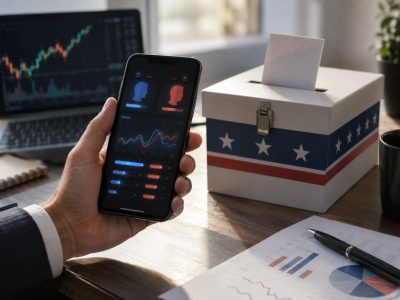
 Political prediction markets have expanded rapidly ahead of the 2026 U.S. midterm elections. By August 10, traders had placed about $133 million on congressional races across Kalshi, Polymarket and Polymarket US, findings from the Anti-Corruption Data Collective show. That already exceeded the $92.4 million wagered during the entire 2024 congressional cycle.
These markets turn political expectations into tradable contracts. A contract may pay $1 if a party wins the House and nothing if it loses. The price therefore acts as a rough estimate of how traders view the probability of that outcome. Unlike a poll, which asks people what they think or intend to do, a prediction market requires participants to put money behind their expectations.
Can Money Produce Better Forecasts?
Supporters argue that this financial incentive helps markets process information quickly. Traders can react within minutes to polling releases, economic reports, scandals, endorsements or campaign events. Research by economists Justin Wolfers and Eric Zitzewitz published through the National Bureau of Economic Research found that well-designed prediction markets can aggregate dispersed information and often produce useful forecasts.
There is also evidence that market forecasts can sometimes perform better than individual opinion polls. However, that does not make them universally superior. Research published in Public Opinion Quarterly found that surveys asking voters who they expected to win performed slightly better than prediction markets across several U.S. presidential elections. Different forecasting tools measure different things, so treating any single one as definitive can be misleading.
What Happens When a Few Traders Dominate?
The strongest challenge to the “wisdom of crowds” argument is that the crowd may be smaller than it appears. An August 2026 analysis by the Anti-Corruption Data Collective found that just 1% of wallets accounted for 68% of Polymarket Global’s midterm trading volume. Ten wallets generated about 17% of trades.
That concentration matters because a displayed probability can look like a broad public judgment even when much of the trading comes from a relatively small number of participants. Large traders may have better information, which could improve prices. They may also simply have stronger opinions and more capital.
When Political Expectations Become Assets
The deeper issue is influence. Prediction-market prices are increasingly discussed alongside polls and election models. The Brennan Center for Justice has warned that widely circulated betting odds could confuse voters or strengthen misleading narratives if market prices are treated as evidence of what voters have actually decided.
There is also a feedback problem. Traders react to political news, but politicians, journalists and voters may then react to the prices created by those traders. A market originally designed to forecast politics can become part of the political information environment itself.
A Useful Signal, With Important Limits
Prediction markets are unlikely to replace polling. They may instead become another layer of election forecasting, alongside surveys, statistical models and expert analysis. Their speed is valuable, and financial incentives can uncover information that conventional measures miss.
Still, market prices should be read as prices, not votes. As election contracts become larger and more visible, transparency about who trades, how concentrated markets are and how prices move will matter. Turning political expectations into financial assets may improve forecasting, but it also changes who can shape the numbers that the public sees.