 What Public Citizen’s Data Shows
 What Public Citizen’s Data Shows
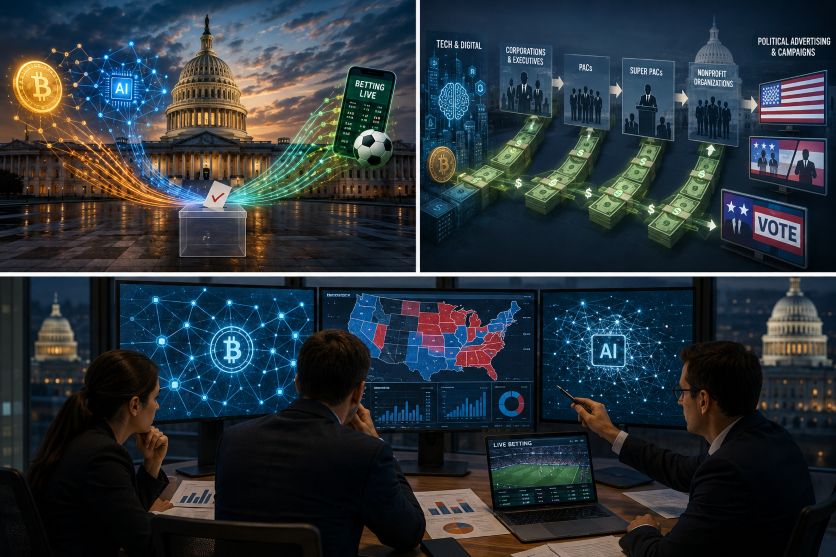
Corporate political spending in the 2026 U.S. midterms reached $517 million through the end of the first quarter, already above the $461 million recorded across the full 2024 election cycle. The analysis found that crypto, technology and online betting companies supplied at least $294 million of that early total.
The pace has continued. Disclosed corporate contributions later climbed to about $646 million through the second quarter. Crypto companies accounted for $206 million, online betting businesses for $76 million, and Big Tech and firms tied to AI and data centers for $62 million. Together, those sectors supplied more than half of reported corporate money.
How Federal Election Commission Rules Shape the Flow
The money rarely travels straight from a company to a candidate. Federal rules allow super PACs to accept unlimited contributions from individuals, corporations, unions and other committees. They can spend that money on independent advertising and other political activity, but they cannot coordinate those expenditures with candidates.
That structure encourages complex networks. Super PACs can fund television spots, digital ads and voter outreach. Affiliated committees can target particular races. Politically active nonprofits can add another layer, since some 501(c)(4) groups do not publicly reveal their donors even when money later reaches election-focused organizations. This can make influence visible in advertising while leaving the original source of the money harder to trace.
What Reuters Found in the New Donor Networks
Crypto’s Fairshake helped establish the current playbook. The model now appears across other sectors. Leading the Future has become a major vehicle for AI interests, while Win for America channels large contributions from online betting companies.
The donors include powerful individuals and companies. Andreessen Horowitz and its founders have given heavily to crypto and AI political groups. Elon Musk has separately put more than $90 million toward federal elections this cycle. Greg Brockman and Anna Brockman have helped fund Leading the Future, while Anthropic has given at least $40 million through Public First Action, a nonprofit group.
Why Regulatory Uncertainty Makes Congress Valuable
These industries are confronting decisions that could reshape their business models. Crypto firms are still seeking durable federal market-structure rules. AI companies face fights over safety standards, data centers, energy use and state regulation. Betting operators are dealing with taxes, state gambling laws and growing competition from prediction markets.
The common thread is uncertainty. A favorable Congress can influence which bills advance, which agencies receive authority and how aggressively emerging industries are supervised. Campaign spending therefore becomes one way to shape the political environment before rules become harder to change.
Technology may have changed the industries writing the checks, but the underlying strategy is familiar. Wall Street, energy, pharmaceuticals and other established sectors have long built political networks around policy interests. Crypto, AI and betting firms are increasingly doing the same, with newer fortunes and newer regulatory fights. The question after November is whether technology created a new political model, or simply a new generation of conventional Washington power brokers.