Who Is Funding the 2026 Midterms? How Crypto, AI and Betting Became Washington’s New Money Powers

What Public Citizen’s Data Shows

Corporate political spending in the 2026 U.S. midterms reached $517 million through the end of the first quarter, already above the $461 million recorded across the full 2024 election cycle. The analysis found that crypto, technology and online betting companies supplied at least $294 million of that early total.

The pace has continued. Disclosed corporate contributions later climbed to about $646 million through the second quarter. Crypto companies accounted for $206 million, online betting businesses for $76 million, and Big Tech and firms tied to AI and data centers for $62 million. Together, those sectors supplied more than half of reported corporate money.

How Federal Election Commission Rules Shape the Flow

The money rarely travels straight from a company to a candidate. Federal rules allow super PACs to accept unlimited contributions from individuals, corporations, unions and other committees. They can spend that money on independent advertising and other political activity, but they cannot coordinate those expenditures with candidates.

That structure encourages complex networks. Super PACs can fund television spots, digital ads and voter outreach. Affiliated committees can target particular races. Politically active nonprofits can add another layer, since some 501(c)(4) groups do not publicly reveal their donors even when money later reaches election-focused organizations. This can make influence visible in advertising while leaving the original source of the money harder to trace.

What Reuters Found in the New Donor Networks

Crypto’s Fairshake helped establish the current playbook. The model now appears across other sectors. Leading the Future has become a major vehicle for AI interests, while Win for America channels large contributions from online betting companies.

The donors include powerful individuals and companies. Andreessen Horowitz and its founders have given heavily to crypto and AI political groups. Elon Musk has separately put more than $90 million toward federal elections this cycle. Greg Brockman and Anna Brockman have helped fund Leading the Future, while Anthropic has given at least $40 million through Public First Action, a nonprofit group.

Why Regulatory Uncertainty Makes Congress Valuable

These industries are confronting decisions that could reshape their business models. Crypto firms are still seeking durable federal market-structure rules. AI companies face fights over safety standards, data centers, energy use and state regulation. Betting operators are dealing with taxes, state gambling laws and growing competition from prediction markets.

The common thread is uncertainty. A favorable Congress can influence which bills advance, which agencies receive authority and how aggressively emerging industries are supervised. Campaign spending therefore becomes one way to shape the political environment before rules become harder to change.

Technology may have changed the industries writing the checks, but the underlying strategy is familiar. Wall Street, energy, pharmaceuticals and other established sectors have long built political networks around policy interests. Crypto, AI and betting firms are increasingly doing the same, with newer fortunes and newer regulatory fights. The question after November is whether technology created a new political model, or simply a new generation of conventional Washington power brokers.
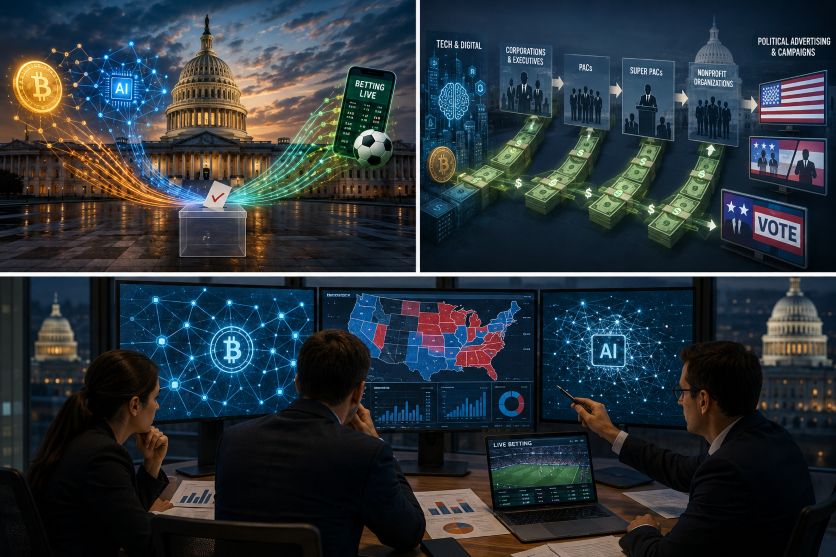
The New Political Kingmakers: How Crypto, AI and Betting Money Are Reshaping the 2026 Midterms

Capitol Money, Tech, and Politics

Corporate political spending has reached record levels ahead of the 2026 U.S. midterms. Reuters, citing data compiled by Public Citizen, reported that U.S. companies spent $517 million on House and Senate races during the 15 months through March 2026. That already exceeds the $461 million corporate-spending record for the entire 2024 election cycle. Crypto, technology and online gaming interests accounted for at least $294 million of the current total.

The surge reflects a changing political economy. Industries built around cryptocurrency, artificial intelligence and digital betting are expanding while lawmakers are still deciding many of the rules governing them. For businesses whose future costs, products and market access depend heavily on regulation, elections can influence who eventually writes those rules.

Why Regulation Raises the Stakes

Crypto provides the clearest example. Coinbase, Ripple and Andreessen Horowitz helped finance Fairshake, the industry’s powerful super PAC. Reuters reported that Fairshake began 2026 with a $193 million war chest and had roughly $130 million remaining when the report was published. Its strategy has generally focused on supporting crypto-friendly candidates rather than aligning exclusively with one party.

The policy stakes remain substantial. The U.S. Securities and Exchange Commission proposed a tailored crypto-asset framework on August 18, including registration exemptions and a conditional safe harbor for certain investment contracts. Meanwhile, the U.S. Treasury Department is developing rules to implement the GENIUS Act, including requirements governing payment stablecoin issuers.

How Does the Money Reach Elections?

The funding routes matter. Traditional corporate contributions to federal candidates remain restricted. However, the Federal Election Commission says super PACs may accept unlimited contributions from corporations, individuals and labor organizations for independent political spending. Those groups cannot coordinate their expenditures with candidates.

Money can also move through affiliated PACs and nonprofit organizations. That makes it important to distinguish a company’s spending from donations by founders, executives or outside organizations sharing similar policy goals. Reuters found that AI-related groups, companies and executives have become increasingly active, while OpenAI has publicly said outside political organizations do not represent its views.

AI and Betting Join the Political Race

AI firms have especially large incentives to shape an unsettled regulatory environment. Questions include federal versus state oversight, model disclosures, safety requirements and national-security rules. The White House has pursued a more uniform federal AI framework while challenging state rules it considers overly burdensome.

Betting companies face another regulatory puzzle. Reuters reported that DraftKings, FanDuel, Fanatics and bet365 contributed more than $72 million during the cycle. Prediction markets face separate disputes over whether some sports contracts belong primarily under federal commodities law or state gambling regulation. A recent federal appeals ruling involving Kalshi highlighted that continuing jurisdictional conflict.

A New Model of Political Power?

Technology companies are hardly the first industries to seek political influence. Finance, pharmaceuticals and energy have operated political networks for decades. What has changed is how quickly digital-era fortunes can become major election resources.

The deeper question is whether crypto, AI and betting businesses are simply becoming conventional Washington power centers. The alternative is more significant: rapidly accumulated technology wealth may be creating a faster model for turning commercial success into political influence while regulatory frameworks are still being built. The 2026 midterms may provide an important test of how durable that model becomes.